
Choosing a software company in Saudi Arabia It is not only a "project execution" decision; it is an operational and investment decision that affects
growth speed, service quality, compliance, and customer experience. This guide is designed for decision-makers in Saudi Arabia and GCC countries
the Gulf: It explains the available options, evaluation criteria, common implementation mistakes, and a practical roadmap to reduce risks and increase
the chances of success.
Publication date: Last updated: Prepared by: CloudX team
1) Defining the core concept
The term a software company (or a software company / technology company
information / a software development company) may be used to refer to different entities: a development team
for a digital product, a custom project implementation company, an integrations and systems provider, or a company that builds and operates a platform. The differences are not only linguistic;
they affect contracting, pricing method, risk level, and who bears responsibility when setbacks occur.
What are you actually buying when contracting with a software company?
- Execution capability: Turning business requirements into software that works and is maintained over the long term.
- Governance system: Managing project scope, change, quality, and releases.
- Operational responsibility: Monitoring, support, vulnerability remediation, and service continuity.
- Compliance and security: Controls and policies to protect data and technical assets in line with Saudi market requirements.
Quick diagnostic question
- Is the goal a digital product whose features evolve continuously? Or an internal system to reduce
costs and improve operations? - Does project success depend more on integrations (payments/shipping/ERP/CRM) than on "screens"?
- Do you have an internal technical team leading decisions, or is technology managed by operations management?
2) Available options and when to choose each option
In Saudi Arabia and the Gulf, the most common implementation patterns fall into four tracks: an internal team, an implementation company (outsourcing),
freelancers/small teams, or ready-made solutions (SaaS/off-the-shelf). The right choice depends on data sensitivity, speed to
market, integration complexity, and your ability to manage the product after launch.
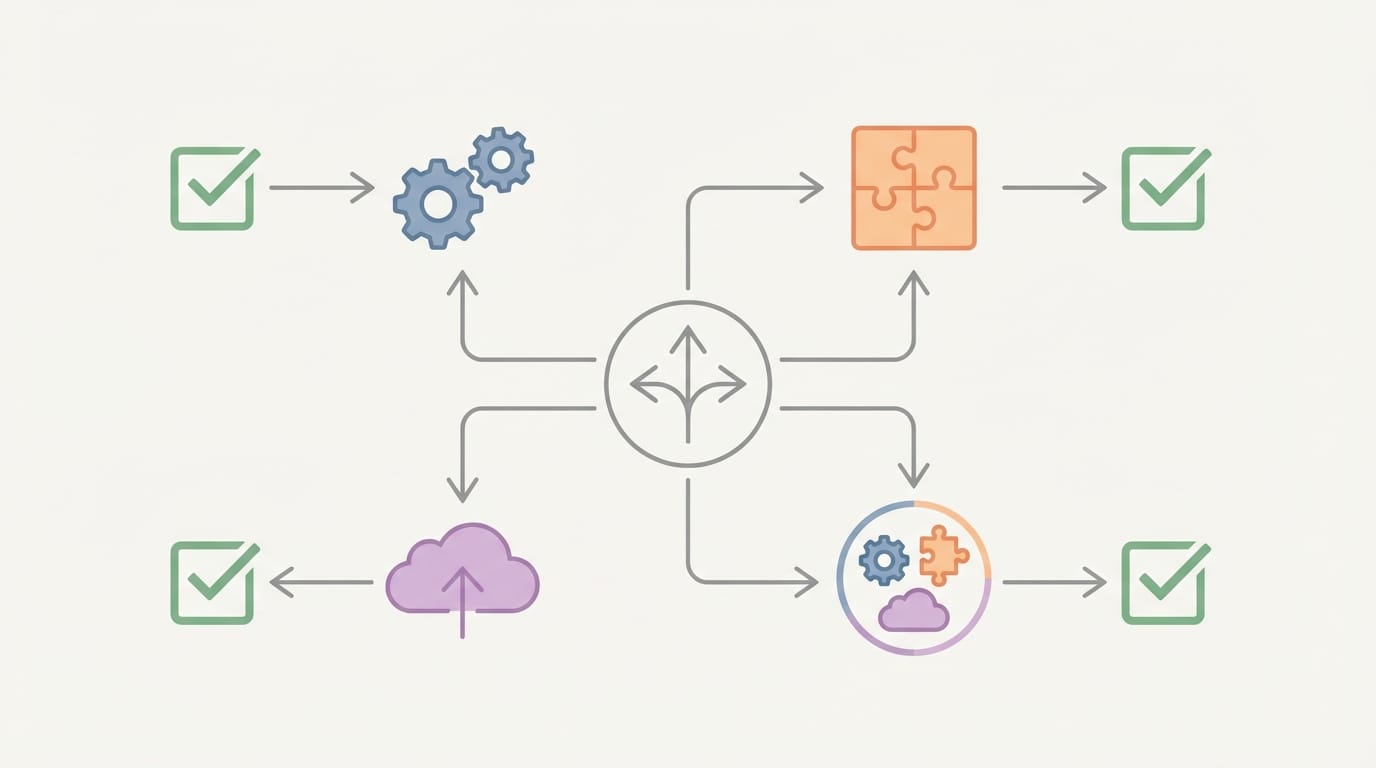
Quick comparison of implementation options
| Option | When it suits you | Common risks | How to reduce risks |
|---|---|---|---|
| Internal development team | Long-lived product, deep domain knowledge, ongoing operating budget | Hiring difficulty, slow start, dependence on individuals | Clear technical leadership, documentation, and a phased hiring plan |
| Development company (project/dedicated team) | You need delivery speed with governance and quality, and medium to high complexity | Poor scope management, delivering "code" without operational readiness | A contract that defines deliverables + operational guarantees + a knowledge transfer plan |
| Freelancers/small teams | Prototype or very narrow scope | Inconsistent quality, weak security coverage, continuity interruptions | Code reviews, acceptance criteria, and resource backup |
| Ready-made solution (SaaS/off-the-shelf) | Standard operations (such as standard CRM), and you want a quick start | Customization limits, cumulative cost, difficult integrations | Verify the API, data export clauses, and a fallback plan |
When is a hybrid approach best?
- A ready-made solution for standard functions with Custom development for competitive advantage (such as a
pricing/recommendation/special workflow engine). - Fast launch with an MVP, then gradual expansion with security and compliance controls.
If you are moving toward custom development and want a professional implementation framework, review the service page:
custom solution development.
3) Business value and its impact on growth
Many software projects stall because the discussion starts with "What is the right technology?" instead of "What value do we want
to maximize?" Your company does not need more code; it needs a clear decision on: reducing operating costs, increasing conversion, improving
compliance, or opening a new revenue channel.
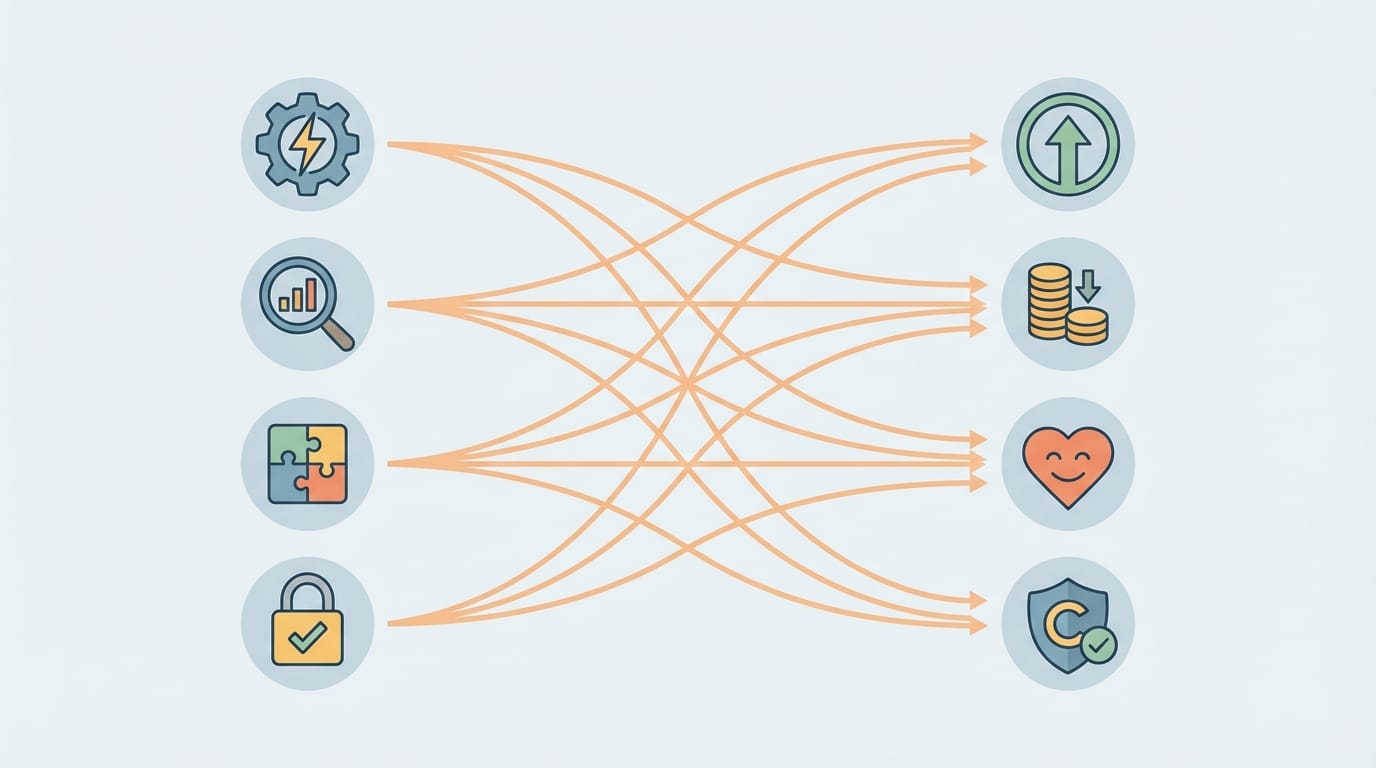
Questions that turn requirements into measurable value
- Which "metric" will improve within 90 days after launch? (such as order completion time, conversion rate, error rate).
- Which decisions will become faster because data will be unified?
- Which processes consume human time and can be automated without compliance risk?
Common patterns in the Saudi and Gulf market
- Expansion across multiple branches/cities: The need to unify operations, permissions, and workflows.
- Local integrations: Connecting payments, shipping, invoicing, and internal systems within one experience.
- Data sensitivity: Increased focus on privacy and governance of data transfer outside the Kingdom in accordance with
regulations.
If you are balancing between a "ready-made solution" and a "custom solution," or want neutral technical advice on the best path, you can share a summary
of requirements and business context to get executive guidance:
Contact Us.
4) Most commonly used types and models
When searching for a software company or an IT company, you will encounter different operating models.
Understanding them helps you choose a model that reduces risk and increases transparency.
Most common contracting models
| Model | Suitable for | Strength | Weakness | Practical success condition |
|---|---|---|---|---|
| Fixed price (Fixed Scope) | Clear and stable requirements | Budget clarity | Scope and change disputes | Scope document + acceptance criteria + change management |
| Time and Materials (T&M) | An evolving product or unfolding requirements | High flexibility | Concern about "effort inflation" | Weekly governance + progress indicators + a maximum budget cap |
| Dedicated Team | A long-term roadmap and continuous development | Continuity and accumulated knowledge | Requires product leadership from your side | A strong Product Owner + a clear backlog |
| Hybrid approach | A mix of defined deliverables and continuous evolution | A balance between control and flexibility | Contractual complexity | Break the work into measurable phases/packages |
How do you read promises like "the best software company in Saudi Arabia" in practical terms?
- Do not look for the "slogan"; look for Operational evidence: how they manage requirements, testing, releases,
and quality measurement. - Ask for examples of engineering decisions (why they chose a specific approach, and how it affected
performance/cost/risk). - Make sure there is an operations setup after launch: monitoring, alerts, backups, and a response plan
for incidents.
5) User experience and its impact on conversion
Even "internal" projects are affected by user experience: complex interfaces mean longer training, more errors, and lower adoption. As for
customer-facing applications, user experience directly affects conversion and retention.
What should management measure (not just the "look of the interface")
- Time to value: How many steps until the user completes the core task?
- Drop-off points: Where does the user get stuck? (long form, complex registration, unclear verification)
- Consistency: The same logic across all screens reduces errors and increases speed.
- Accessibility: Support for different devices, right-to-left direction, and mobile-first experiences.
UX deliverables that reduce risk
- User flow maps for core cases and exceptions.
- Testable prototypes before development to avoid rework.
- A design system that improves consistency and reduces development time.
Because user experience is often linked to web pages as well, this related guide may help when building digital interfaces:
Web Design Company in Saudi Arabia: A Practical Guide.
6) Core integrations (payments, shipping, internal systems)
In Saudi Arabia, integration failures are more common than interface failures themselves. The reason: different data sources, unclear "source of
truth," and conflicts between security/compliance requirements and the integration method. Any software company in Riyadh or any
other city should demonstrate clear maturity in integration architecture.
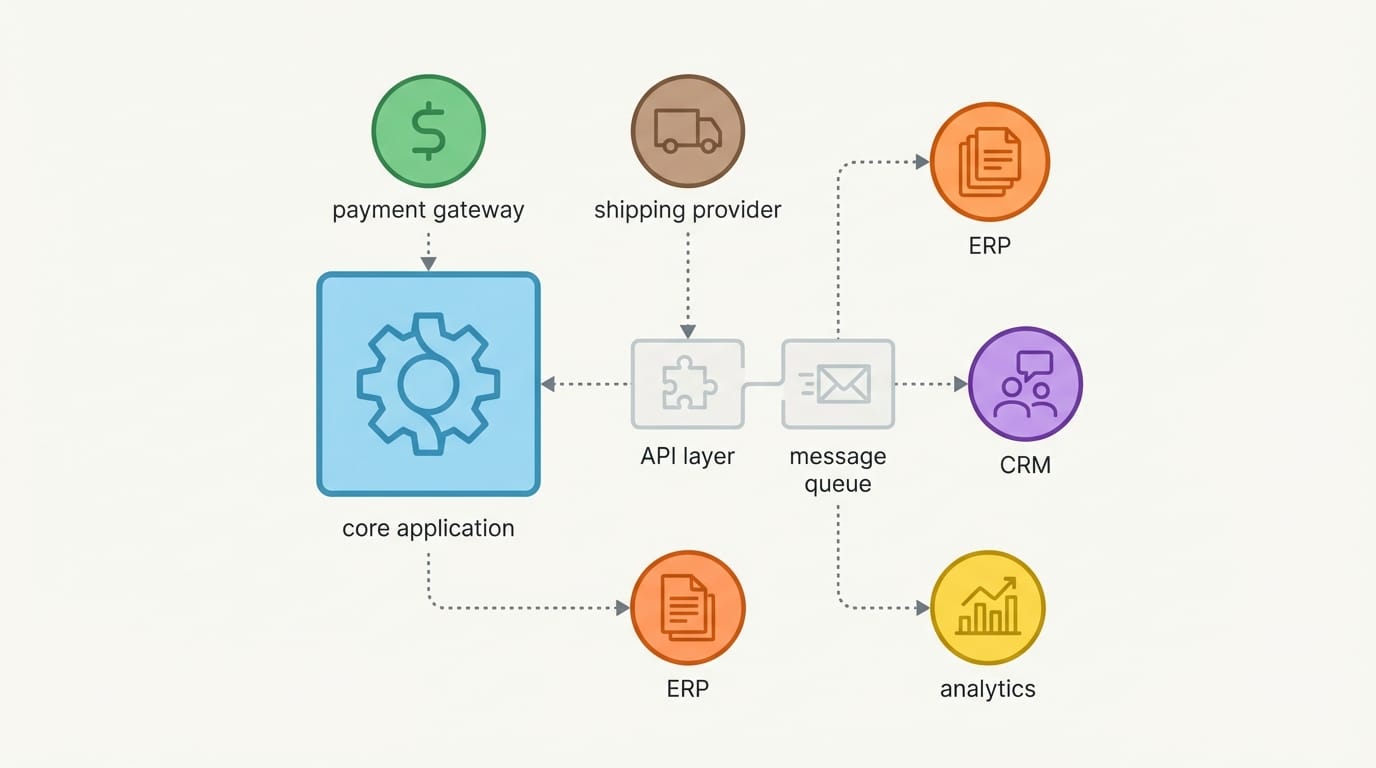
The most common integrations in enterprise projects
- Payment: Payment gateways, settlement, refunds, and linking payment status with orders.
- Shipping and delivery: Shipment creation, status tracking, returns processing, and address synchronization.
- Internal systems: ERP, CRM, HR, inventory management, or an invoicing system.
- Identity and permissions: SSO, roles, fine-grained permissions, and auditing.
3 decisions that reduce complexity from the start
- Define the "source of truth" for each data entity: Customer/order/product/invoice... where is it read
and written? - Design the API clearly: API versioning, data contracts, and traceable error handling.
- Separate integrations from the interface: An integration layer reduces the impact of
external changes.
7) Performance, security, and scalability
Performance and security are not "extra features." If your business suddenly expands (campaigns, seasons, geographic expansion), a non-scalable design will turn
growth into service disruption or degraded experience. At the security level, any vulnerability or data leak creates operational,
reputational, and compliance risk costs.
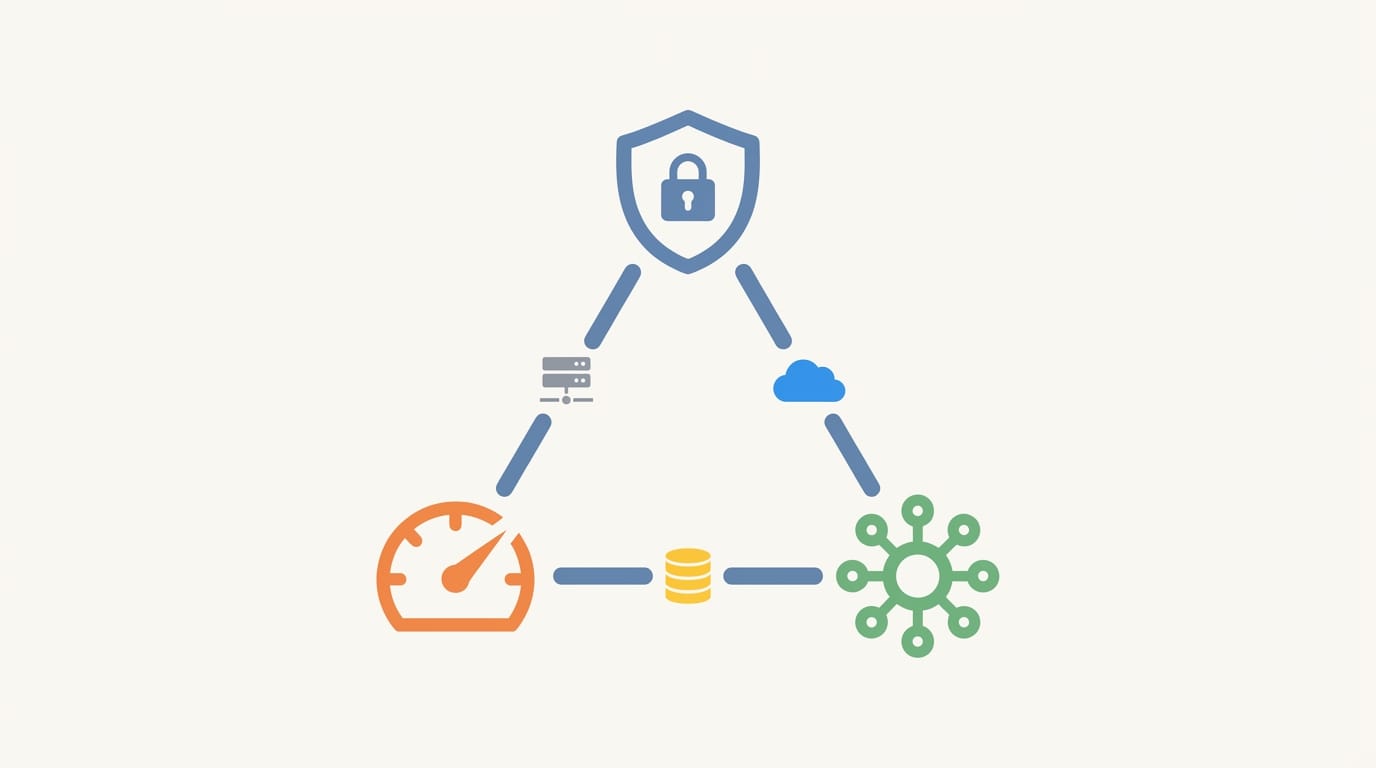
Executive performance checklist
- Agreed performance indicators: response time for critical interfaces and load tolerance benchmarks.
- Well-planned caching for common data with clear invalidation policies.
- Load testing before launch and after every major change.
- Operational monitoring: logs, request tracing, and alerts during outages.
Security checklist (understandable for non-technical people)
- Identity and access management: Least privilege, with periodic reviews.
- Encryption: Encrypt data in transit, and at rest when required.
- Vulnerability management: Updates, periodic scanning, and an incident response plan.
- Backup and recovery: Recovery Time Objective (RTO) and Recovery Point Objective (RPO).
When do you need a more advanced architecture?
- When there is high seasonality in traffic or transactions.
- When there are multiple usage channels (web, app, and partner APIs).
- When there are asynchronous operations (notifications, batch processing, multiple integrations).
8) Common mistakes and how to avoid them
In projects software companieserrors are often not purely technical; they are governance and decision-definition errors.
These are the most frequent pitfalls in enterprise environments:
Scope and requirements mistakes
- Overly general requirements: They lead to conflicting interpretations and mid-implementation changes.
- Ignoring exceptions: The “standard case” works, but cancellation/return/rejection cases break the system.
- Deferring data decisions: Then reporting or billing conflicts appear later.
Contracting and operations mistakes
- Focusing on delivery, not operations: Receiving code without monitoring or a support plan.
- Lack of clear acceptance criteria: Disputes over “Is it complete?”.
- Reliance on one person: From both sides, which increases interruption risk.
Security and compliance mistakes
- Collecting more data than necessary: It increases privacy risks and complicates compliance.
- Sharing data with a third party without controls: Especially when external providers are involved (payments/shipping/analytics).
- No incident response plan: Which lengthens recovery time and amplifies the impact.
9) A practical step-by-step execution framework
This is an execution framework you can use when choosing a software company in Saudi Arabiawhether it is a new project
or rebuilding an existing system. Goal: increase transparency and reduce surprises.
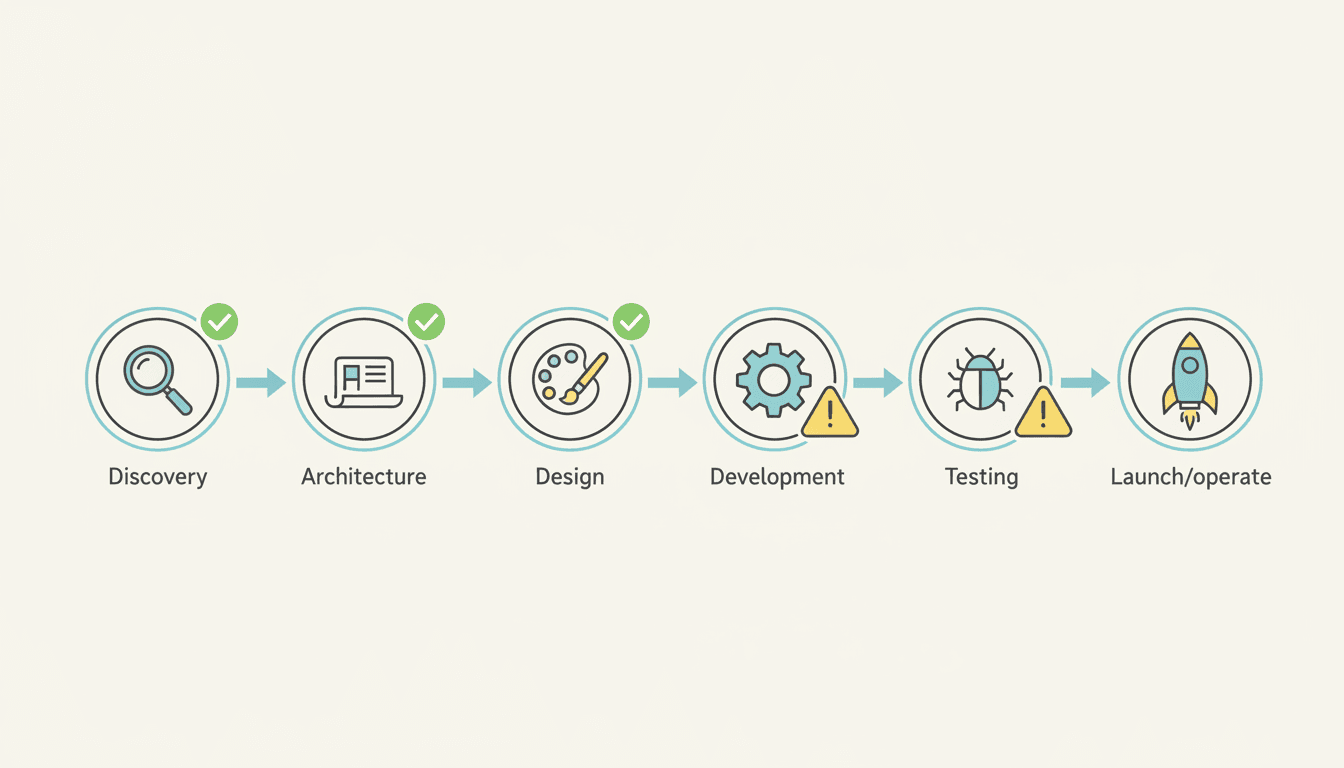
Phase 1: Define the goal and MVP scope
- Define one primary goal (reduce process time / increase conversion / reduce errors).
- Specify what “will not be built” in the first version to avoid scope creep.
- Write 10-20 user stories that represent 80% of the value.
Phase 2: Requirements and data discovery (Discovery)
- Map current processes against target processes.
- Inventory systems, integrations, and constraints.
- Define the data model and source of truth.
Phase 3: Architecture and security design
- Choose the hosting model (cloud/on-prem/hybrid) based on data sensitivity and compliance requirements.
- Design the integration layer and API interfaces.
- Define core security controls: permissions, encryption, logs, backups.
Phase 4: Build and early trials
- Develop in short iterations with regular demos for stakeholders.
- Automated tests as much as possible for critical functions.
- A testing environment that mirrors production using non-sensitive data.
Phase 5: Launch and operations
- A gradual launch plan (Pilot) when possible to reduce risks.
- Monitoring metrics, alerts, and a rollback contingency plan.
- Train users and document “how we work,” not just “which buttons we click.”
Phase 6: Continuous improvement
- A backlog prioritized by value and operational impact.
- A monthly review of performance, errors, and security requirements.
- Governance of integration changes and external parties.
If you are looking for a clear execution path from analysis to operations, review:
to execute an integrated project.
10) When is a custom solution the right choice
“Custom development” does not always mean better. But it becomes the right option when the competitive advantage is in workflow
work that is your own, or in data that needs unification and control, or when an off-the-shelf solution creates
operational constraints that cost you more in the long run.
Strong indicators that a custom solution is suitable
- Non-standard processes (multiple approvals, dynamic pricing, complex exception policies).
- Many integrations that require a central “backbone” to connect systems and govern data.
- High privacy/data residency/audit requirements that require deeper control.
- A clear 12-month product roadmap with continuous changes.
And when might it not be suitable?
- If the core problem is “user adoption,” not technology.
- If the processes are standard and can be covered by an off-the-shelf solution without painful gaps.
- If internal governance is not available (product owner, quick decisions, and stakeholder involvement).
If you want a technical and execution assessment before committing, you can speak with a specialized team about options suitable for your environment:
a professional service for companies.
Related articles
Latest articles related to software companies and app and website design in Saudi Arabia

Software Development Companies in Saudi Arabia: Technical and business evaluation criteria before contracting
Why does choosing a software partner directly affect business results? Choosing software companies in Saudi Arabia is not only a technical procurement task, but…

Software Development Company: When Do You Need Custom Development Instead of Off-the-Shelf Solutions?
Why is the buy-or-build decision a critical business decision in Saudi Arabia? Choosing between ready-made solutions and custom development is not only a technical decision, but…

Best Software Company in Saudi Arabia: 12 Evaluation Criteria Before Contracting
Choosing the best software company in Saudi Arabia is not only a "technical vendor" decision; it is an operational and financial decision that affects product launch speed,…
Frequently Asked Questions (FAQ)
1) What are the key factors that determine the cost of contracting with a software company in Saudi Arabia?
Cost is affected by scope complexity, number of integrations, level of security and compliance, and post-launch operational expectations
(monitoring/support/warranties). The contracting model (fixed/time and materials/dedicated team) also affects how the budget is controlled and
change is managed. It is better to build the budget in phases with measurable deliverables instead of one all-inclusive number.
2) How long does implementing a software project for companies usually take?
The duration depends on requirement clarity, integration maturity, and stakeholder availability. Often an MVP can be launched within
weeks to a few months if scope is reduced and focus is on core cases, while integrated multi-
department systems may require sequential phases. The real timeline is determined after a short Discovery phase that identifies risks and dependencies.
3) What is the difference between a software company that executes a project and one that provides a dedicated team?
A “project” model focuses on delivering a defined scope with deliverables and acceptance criteria, while a “dedicated team” focuses on continuous capability
to develop the product over time. A dedicated team suits a long roadmap, but it requires a strong product owner on your side to define
priorities. In contrast, a fixed project reduces ambiguity but is sensitive to any later changes.
4) How do I make sure the company will build a scalable system, not just a version that works now?
Ask for clear indicators: load tests for critical scenarios, observability and monitoring (Logs/Tracing), and an architecture plan to absorb growth
(such as service separation or an integration layer). Design decisions and why they were made should also be documented, and performance criteria should be
measurable before launch. Scalability is not just a “bigger server”; it is data architecture, integrations, and operations.
5) What privacy and data protection requirements should be considered in Saudi Arabia?
You should consider obligations for data collection and processing, individuals’ rights, and governance of data sharing, especially when dealing with
external parties or transferring data outside the Kingdom. As an official reference, review the data protection portal of the competent authority:
SDAIA – Organizational Data Protection
and the implementing regulations related to transfer and disclosure:
PDPL Implementing Regulations.
6) Should my company apply the National Cybersecurity Controls (ECC)?
That depends on the nature of the entity, the sensitivity of technical assets, and regulatory obligations, but adopting minimum controls as a framework
practically reduces risks and improves incident response readiness. ECC can be used as a reference to assess maturity and identify gaps
even if you are not a government entity. Review the reference from the national authority:
NCA – Essential Cybersecurity Controls.
7) What are the most important implementation risks I should include in the contract from the beginning?
Focus on: scope change management, acceptance criteria, ownership of code and documentation, quality assurances, and the operations and support plan
after launch. Add clauses for security and performance testing, and a knowledge-transfer mechanism to avoid dependence on individuals. The more
The clauses were operational and measurable, and disputes decreased.
8) What should I ask about hosting and cloud services within Saudi Arabia?
Ask about data location, backup and recovery policies, and who is responsible for security in the shared responsibility
model. If a cloud provider is part of the solution, it is useful to review the regulatory framework for cloud computing services
through the regulatory authority:
CST – Cloud Computing Services Provisioning Regulations.
9) How do I evaluate the quality of a development team without being a technical expert?
Evaluate the process instead of jargon: do they have a test plan, code review, release management, and incident monitoring? Ask for a sample
of documentation (Architecture + API + Operations) and an example of a weekly progress report. A good company makes work visible
to management through clear metrics.
10) What is the best way to start contracting and reduce risk before committing to a large project?
Start with a short Discovery phase with defined deliverables: MVP scope, data model, architectural vision, and a phased plan with an estimate
of risks and dependencies. Then move to phased implementation with review checkpoints and gradual rollout. This approach reduces rework
and reveals surprises early.
Your next practical step
If you are in the selection stage a software company in Saudi Arabia or want to review the scope of an existing project before starting,
you can send a requirements summary (project goal, current systems, and required integrations) to get executive guidance
that helps you make a well-informed decision: Contact Us.